Inflation & Interest Rates
Interest rates work like gravity on asset prices, as David Senra puts it. Felix Zulauf argues a new secular uptrend has begun, Richard Bernstein explains why Fed cuts can push long rates higher when nominal GDP runs hot, and Acquired revisits the 1973 OPEC embargo that ended postwar growth.
Viewpoints
Zulauf: Fed rate cuts without fundamentals signal bond market trouble ahead
Felix Zulauf
“Interest rates are in a new secular uptrend, with the recent decline from 5% representing merely a correction that will stay between 3-5% before breaking higher. The Federal Reserve is cutting rates without fundamental economic justification, which signals danger for bond markets as investors fear central banks maintaining excessively easy monetary policy for too long in a fiat currency system. This asymmetric policy approach victimizes bond holders and could lead to much higher inflation in 2026-2028 if authorities intervene to prevent rising yields.”
Bernstein: Nominal GDP growth sets long-term rates regardless of inflation vs real growth mix
Richard Bernstein
“When the Fed cuts rates while nominal GDP runs at 5-6%, long- term interest rates (like the 10-year Treasury) are likely to rise, not fall. This occurs because nominal GDP growth—whether driven by real productivity gains or inflation—determines long- term interest rates, making it illogical to expect 10-year yields in the low 4% range when nominal growth is significantly higher. Even a massive AI-driven productivity boom would generate real growth that, combined with any inflation, would push nominal GDP higher and put upward pressure on the 10-year yield.”
Harold J: Federal Reserve's historical record undermines its credibility on monetary policy
Harold J
“The Federal Reserve's track record since its 1913 founding reveals a pattern of policy failures, including overseeing price doublings during both World Wars, contributing to the Great Depression, financing the Great Inflation of the 1970s, and inverting the yield curve before the 2008 financial crisis. This historical record suggests that discretionary monetary policy by the Fed is fundamentally problematic, and the institution's austere reputation is belied by the facts of its actual performance.”
Masturzo: Fixed income now attractive after decades of falling rates
Jim Masturzo
“After 30-40 years of declining interest rates that made fixed income unattractive at 1% or less, the Federal Reserve's rate increases to fight inflation have created a new opportunity in bonds. With yields now at 4-4.5% and the Fed signaling rates won't return to zero soon, fixed income has become an appealing low-risk asset class again after years of offering little value to investors.”
Key Moments
Jeremy: Unemployment uptick historically predicts recession despite soft landing hopes
Legend Investor Jeremy
“Historical patterns show that when unemployment rises by 0.5-0.6 percentage points, it reliably predicts recession (70-100% of the time). Currently at 0.7% above baseline, along with yield curve inversion and other leading indicators, all conditions that have historically preceded recessions are present, suggesting the soft landing scenario is unlikely despite market optimism.”
Pilecki: Interest rates creating bifurcated economy
Derek Pilecki
“Current interest rates are restrictive and have created a bifurcated economy where AI and non-interest-rate-sensitive sectors are performing well, while interest-rate-sensitive sectors like housing and autos are struggling significantly. Existing home sales have dropped from 5.5 million to below 4 million units annually, and real estate development has stalled as developers refuse to borrow at 8% rates.”

Gilbert & Rosenthal: 1970s oil shocks drove extreme inflation and interest rates
Ben Gilbert & David Rosenthal
“The 1970s oil crises, starting with OPEC's 1973 embargo that tripled energy prices, ended post-WWII American economic growth and created brutal conditions throughout the decade with unemployment hitting 10%, inflation reaching 12.4% by 1980, and ultimately forcing Fed Chairman Paul Volcker to raise interest rates dramatically. The current concern about rates at 3.5-5% pales in comparison to the extreme measures needed to combat 1970s inflation.”
Senra: Warren Buffett's gravity analogy for interest rates and asset prices
David Senra
“Interest rates function like gravity for asset prices: when rates are low, there is minimal downward pull on valuations, and when rates rise, asset prices fall. Every economic asset—from businesses to farms to apartments—is 100% sensitive to interest rates because investing fundamentally involves exchanging present money for future cash flows, which are discounted more heavily when rates are high.”
Powered by Symmerai — a living index of public discourse. Request early access →
Related concepts
Other relevant clips
Stories to Make You a Smarter Investor w/ Kyle Grieve (TIP792)
Kyle Grieve
“…00s 3.2% 2000s 2.5%. But each century has its own story and inflation has stabilized a lot in the 20th and 21st century due to the formation of the Federal Reserve in 1913. As Forester points out in his book, moderate inflation is actually manageable and is th”
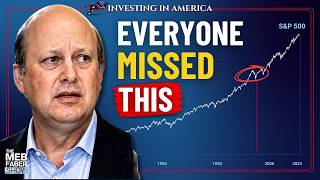
Investors Believe This. 200 Years of Data Doesn't Agree
Bryan Taylor
“…there is you have an increase in interest rates because of inflation. And then the government reduces the inflation, which then reduces the interest rates. The first interest rate pyramid occurred from around 1896 until 1920, mainly driven by World War I and”
Lyn Alden on How Fiscal Dominance Reshapes Markets (TIP815)
Lyn Alden
“…re, say treasuries paying versus forward kind of break even inflation expectations as measured by like the tips market for example. That's that's a common way to do it. I think a better method is to look at money supply growth for the jurisdiction in question.”
When Do You Get The BIGGEST Return In Equity Markets? (Goldman Sachs' Peter Oppenheimer Reveals)
Peter Oppenheimer
“interest rates and inflation terrible combination really for financial returns but it was also a period where you got a A lot of um geopolitical tensions where World Trade growth actually slowed again you saw a lot of increases in in taxation and Regulation an”
Can The Bull Market Continue? Surprising Lessons from 100 Years of Data (Bryan Taylor Explains)
Bryan Taylor
“…20% but then after vuler came in he was determined to fight inflation and as inflation went down interest rates followed them and then every time that there was a financial crisis the Central Bank simply lowered interest rates and so interest rates went from a”

Current Market Conditions & Poor Charlie's Almanack w/ Stig Brodersen & Clay Finck (TIP684)
Stig Brodersen
“…fectively 0% and then the FED decided they wanted to combat inflation raise rates they took rates to over 5% 5.25 that was in the fall of 2023 and here in 2024 they've done two rate Cuts bringing the target rate to 4 and a half% and inflation overall seems to”

Wise PLC: Competitive Moat & Valuation Framework w/ Kyle Grieve & Daniel Mahncke (TIP806)
Kyle Grieve
“…just my general thoughts, if central banks want to rein in inflation, then I think pausing the printing press is probably a good start, which is going to be good for interest rates um staying at these elevated levels. Yeah, unfortunately, I have to say the sa”
Inside the Mind Of A Successful Trend Follower: A Conversation with Doug Greenig
Doug Greenig
“…h is now pretty well behaved we had this monetary expansion inflation and now things are pretty much back on the trend line and so with inflation coming down and policy rates as high as over 5% real interest rates are very high so the fall of inflation sort of”